
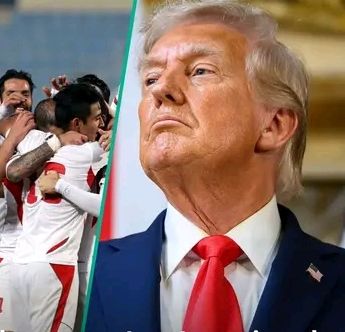
Trump’s Safety Warning to Iran’s National Team Raises Questions Ahead of the 2026 FIFA World Cup
Tensions between the United States and Iran have spilled into the world of international sports after U.S. President Donald Trump issued a controversial and ambiguous warning regarding the participation of Iran’s national football team in the upcoming 2026 FIFA World Cup.
The tournament, scheduled to be jointly hosted by the United States, Canada, and Mexico, is expected to be the largest World Cup in history. However, escalating geopolitical tensions between Washington and Tehran have cast uncertainty over Iran’s involvement in the global sporting event.
Speaking amid ongoing military hostilities between the United States and Iran, President Trump suggested that while the Iranian national team would technically be allowed to participate in the tournament, it might not be safe for them to travel to the United States.
In remarks that quickly sparked international debate, Trump stated that the team was welcome to compete but cautioned that attending the tournament might not be advisable “for their own life and safety.” The statement appeared to send mixed signals—affirming that Iran would not be officially barred from the competition while simultaneously discouraging their presence.
The comments followed reports of an escalating military confrontation between the United States and Iran, including recent airstrikes and retaliatory actions that have significantly strained diplomatic relations between the two countries.
Iranian officials have reacted strongly to the ongoing conflict, with some government figures indicating that the national team may not participate in the tournament under the current circumstances. Iranian sports authorities have suggested that the safety of players and staff, along with broader political considerations, could make participation impossible.
Although no formal withdrawal has been confirmed, the possibility of Iran boycotting the World Cup has raised questions about how international football governing bodies would respond if a qualified team declined to participate.
FIFA, the governing body of world football, has so far maintained a neutral stance on the issue. Officials have indicated that all qualified teams remain eligible to participate in the tournament, and there has been no indication that Iran will be excluded from the competition.
FIFA President Gianni Infantino has previously stated that the United States assured the organization that all participating nations would be welcomed for the event. Nevertheless, the political tensions surrounding Iran’s potential participation could create logistical and security challenges for tournament organizers.
The controversy highlights the recurring intersection between geopolitics and international sport. Global tournaments such as the FIFA World Cup often serve as platforms for diplomacy and cultural exchange, yet they can also become arenas where political tensions play out on the world stage.
Iran has been a regular participant in recent World Cups and had already secured qualification for the 2026 tournament. If the team ultimately decides not to attend, it could mark one of the most politically significant withdrawals in modern World Cup history.
With the tournament still more than a year away, the situation remains fluid. Much will depend on how the geopolitical conflict between the United States and Iran evolves in the coming months. Diplomatic developments, security assessments, and FIFA’s policies will all play crucial roles in determining whether Iran’s national team takes the field in 2026.
For now, Trump’s warning has added a new layer of uncertainty to what was already shaping up to be a highly complex geopolitical backdrop for the world’s most watched sporting event.